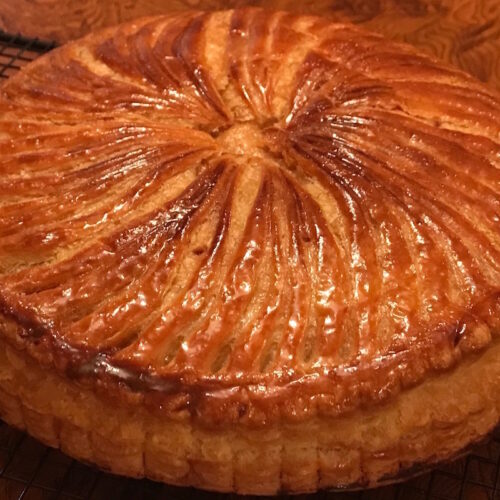
French Galette des Rois Recipe ( King Cake)
French Galette des Rois (King Cake) with super crispy homemade puff pastry layers, perfectly baked and filled with a delicious frangipane (almond) cream to celebrate Epiphany.
QUANTITÉ:10 servings
IMPRIMER
ÉPINGLER
ENREGISTRER
INGRÉDIENTS
For a 24-26 cm (9-10 inch) Galette des Rois
- 1 Puff Pastry You can prepare the classic puff pastry, a quick puff pastry or an inverted puff pastry (links in post) the day before.
Almond Cream filling
- 100 g unsalted softened butter
- 100 g granulated sugar
- 100 g almond flour or ground almonds
- 100 g eggs 2 eggs
- 1 teaspoon vanilla extract rum or almond extract
- 1 ceramic fève or a whole almond
Simple Syrup for Glazing the Galette (after baking)
- 50 ml water
- 40 g sugar
Egg Wash
- 1 egg yolk and a little egg white beaten together
PRÉPARATION
Almond Cream
- Beat the unsalted butter until smooth, then add the sugar and vanilla. Mix gently without whipping to combine.
- Add a small amount of eggs and fold in carefully, without whipping, to prevent the cream from puffing up during baking.
- Continue by gradually adding more egg, then a little almond flour, mixing gently after each addition until all ingredients are fully incorporated.
- Transfer the cream to a piping bag and refrigerate until ready to use.
Glazing syrup for the galette, applied right after baking
- Bring all the ingredients to a boil, then remove from the heat as soon as the sugar is fully dissolved.
- Use the syrup once it has cooled, brushing it over the galette while it is still hot.
Assemble the galette
- Divide the puff pastry into two portions.
- Roll out the puff pastry to a thickness of 3 mm (about 1/8 inch), then refrigerate for 10 minutes to prevent it from shrinking when cut.
- Remove the pastry from the refrigerator and, using a 24 or 26 cm (about 9 1/2 or 10 1/4 inches) pastry ring, cut out a disc.
- Repeat with the second portion of puff pastry.
- Spread the almond cream over the first disc, leaving a 2 to 3 cm (about 3/4 to 1 1/4 inches) border all around.
- Note: As is traditional, remember to tuck a small ceramic fève into the almond cream, about 2 cm (3/4 inch) from the edge. You can replace it with a whole almond. Whoever finds it will be crowned king or queen for the day.
- Lightly moisten the uncovered edges with a little water to help the second pastry layer adhere.
- You can also brush the edges with egg yolk, making sure it does not spill over the sides, as this would prevent the puff pastry from rising properly.
- Cover with the second rolled out pastry. Gently smooth the top with your hand to release any trapped air, then press the edges with your fingers to seal the two layers together.
- Flip the galette onto a baking sheet lined with parchment paper.
- Note: You can keep the galette tightly wrapped in plastic wrap in the refrigerator until the next day, either before or after flipping it.
- Press firmly around the edge to seal the borders well, focusing on the 2 cm (about 3/4 inch) area without filling.
- Using the back of a knife, flute the edges as shown in the photo. This step is optional.
- Brush the top of the galette with beaten egg (1 egg yolk mixed with a little egg white) using a pastry brush, then let it rest in the refrigerator for at least 1 hour, or longer. Brush only the top, without touching the sides, so the puff pastry can rise properly.
- Once the first egg wash has set and no longer sticks to your finger, apply a second coat, then score the galette with the pattern of your choice.
- Using a plate as a guide, trace arcs from the center to the edge of the galette with the back of a knife. Wipe the knife after each pass.
- Start with light strokes, then go over them a second time (without the plate this time) to make the arcs more pronounced. Be careful not to press too hard, so you don’t pierce the pastry. (Edit 2023: I no longer do the second pass. One pass after the second egg wash is enough.)
Baking the Galette des Rois
- A very important step to ensure the puff pastry is fully cooked through
- Preheat the oven to 200°C (400°F).
- Before baking, pierce the galette with a wooden skewer in the center and in six other spots along the scored arcs. This allows steam to escape.
- Lightly moisten the baking sheet under the parchment paper. This helps the puff pastry rise properly.
- Bake the galette on the second rack from the bottom of the oven : 10 minutes at 200°C (400°F), then20 minutes at 180°C (350°F), followed by20 minutes at 160°C (320°F), and finally30 to 40 minutes at 140°C (280°F).
- The total baking time is about 1 hour 20 minutes to 1 hour 30 minutes, depending on your oven. The galette should be deeply golden and very crisp.
- If the top browns too quickly, place a baking tray on the top rack of the oven to shield it.
- As soon as the galette comes out of the oven, brush the cold syrup over the entire surface to give it a glossy finish.
- Enjoy your galette warm or at room temperature, according to your preference.