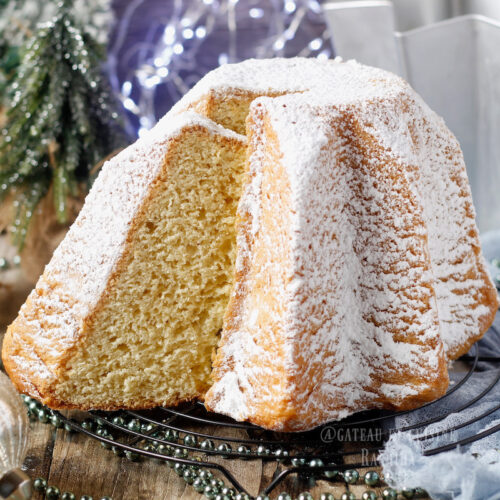
Italian Pandoro, Traditional Christmas Cake
A traditional Italian pandoro recipe, a soft and airy Christmas brioche cake with a fine, delicately pulled crumb and a subtle vanilla flavor.
QUANTITÉ:1 pandoro
IMPRIMER
ÉPINGLER
ENREGISTRER
Matériel
INGRÉDIENTS
Pandoro ingredients (for a 1 kg pandoro mold)
Biga (yeast starter)
- 100 g strong flour at least 12% protein
- 1 egg yolk
- 20 g sugar
- 50 ml milk
- 15 g fresh baker’s yeast
First dough
- Biga yeast starter
- 250 g strong flour at least 12% protein
- 100 g granulated sugar
- 1 egg
- 1 egg yolk
- 100 g unsalted butter
- 3 g fresh baker’s yeast
- 20 ml water
Second dough
- First dough risen
- 100 g strong flour at least 12% protein
- 1 egg
- 30 g granulated sugar
- 100 g unsalted butter
- 5 g salt
- 2 teaspoons vanilla extract
PRÉPARATION
Prepare the biga
- Place the flour and sugar in a bowl or in the bowl of a stand mixer.
- Dissolve the fresh yeast in half of the milk. Mix the egg yolk with the remaining milk, then pour everything over the flour.
- Mix with a whisk or spoon, then work the dough with your hand for 1 to 2 minutes.
- Cover and let rise in a draft free spot until the biga triples in volume. This can take 1½ to 3 hours, depending on room temperature.
Prepare the first dough (first kneading)
- Dissolve the fresh yeast in the water reserved for the first dough.
- Place the biga in the bowl of a stand mixer, then add the dissolved yeast, flour, sugar, egg, and egg yolk.
- Knead for 5 minutes on speed 1.
- Continue kneading for 10 minutes on speed 2, until the dough starts to wrap around the dough hook.
- Add the butter, then continue kneading for 10 minutes on speed 2.
- Note: If the dough warms up and reaches 26°C (79°F), stop kneading, place the mixing bowl in the freezer for 10 minutes, then resume kneading.
- The dough should be smooth, pull away from the sides of the bowl, and wrap nicely around the dough hook.
- It should be very elastic. When doing the windowpane test, you should be able to stretch it very thin until you can see your fingers through it, without tearing.
- Shape the dough into a smooth ball and cover the mixer bowl with plastic wrap.
- Cover with a kitchen towel and let rise until the dough triples in volume. This usually takes about 4 hours, depending on room temperature. Always rely on the volume rather than the time. The dough should triple.
- Tip for rising dough in winter :Place the bowl in a turned off oven with a bowl of boiling water set on the bottom of the oven.If the dough is slow to rise, replace the cooled water with fresh boiling water. This creates a simple homemade proofing environment.
Prepare the second dough (final kneading)
- Once the dough has tripled in volume, place the bowl in the refrigerator for about 20 minutes to cool the dough.
- Remove the dough from the refrigerator, add the flour (100 g / 3.5 oz ) on top, then knead for 5 minutes on speed 1 to incorporate the flour.
- Add the sugar and continue kneading for 5 minutes, still on speed 1.
- Add the butter and knead for 5 minutes on speed 2.
- Add the egg, then continue kneading for about 7 minutes, until it is fully incorporated.
- Add the vanilla and salt, then continue kneading on speed 2 for 10 minutes, until you get a smooth, supple, elastic dough that pulls away from the sides of the bowl and wraps around the dough hook.
- Turn the dough out onto a lightly floured work surface. Fold it over itself 3 to 4 times, bringing the edges toward the center. Flip the dough over, then shape it into a smooth, tight ball. Let it rest uncovered for 20 minutes.
- Generously butter a 1 kg pandoro mold. Shape the dough again into a tight ball, then place it in the mold.
- Cover the mold loosely with plastic wrap and let the dough rise in a draft free spot until it almost reaches the top of the mold. I placed the mold in a turned off oven and let it rise overnight.
- Toward the end of the rise, gently remove the plastic wrap so it doesn’t stick to the dough.
Baking the pandoro
- Preheat the oven to 170°C (340°F), using conventional (static) heat.
- Place the pandoro in the oven and bake for about 55 minutes.
- Check for doneness after 45 minutes. The pandoro should be nicely golden, and a skewer inserted into the center should come out clean.
- Note: The top of the pandoro tends to brown fairly quickly. Keep an eye on it after 20 minutes of baking and loosely cover with aluminum foil if needed.
- Remove from the oven and let rest for 25 minutes, then unmold onto a wire rack.
- Cover with a clean kitchen towel and let cool completely before serving, generously dusted with powdered sugar. You can also slice it horizontally and fill it with mascarpone whipped cream for a more indulgent presentation.